



Two dads, one clear route.
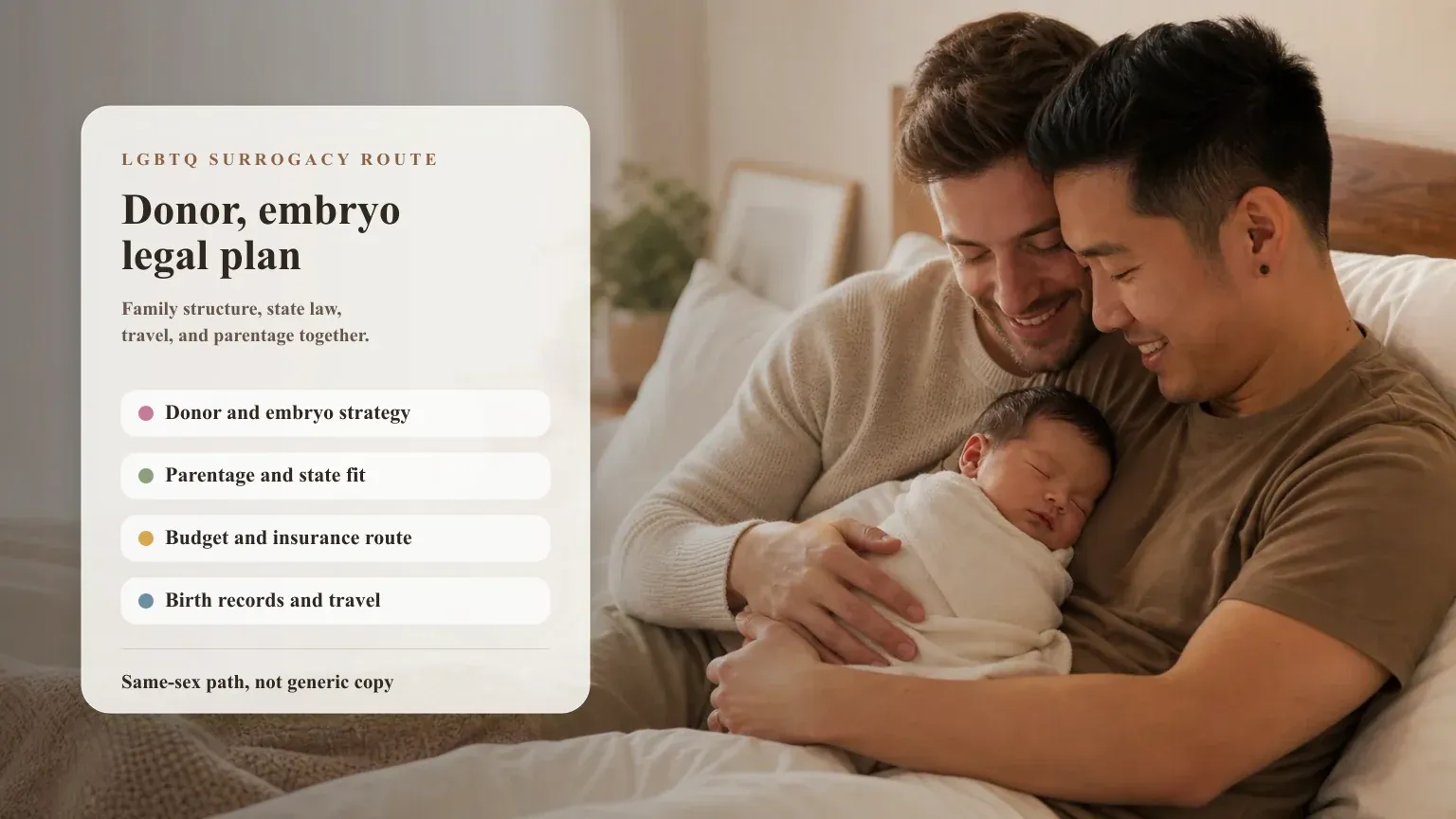
Whose sperm, which egg donor, which carrier, and how both of your names end up on the birth certificate. The decisions specific to a two-dad journey, in the order they actually come up.
Updated July 29, 2026 · Reviewed by Patriot Conceptions Editorial Team
Three questions no one else has to answer.
Most surrogacy guidance is written for couples who already have embryos. Two dads start further back, with three decisions that shape the clinic plan, the budget, and the timeline before matching begins.
Some couples choose one partner for the first child and the other for a sibling. Some split a donor egg cohort and fertilize half with each partner, creating embryos from both dads in a single cycle. Some decide by semen analysis and let the biology settle it. There is no default; decide it deliberately and early, because it drives the clinic plan.
Fresh donor cycle, frozen donor eggs, or a known donor. Anonymity preference, willingness to be known to the child later, medical history depth, and whether the donor will be available for a sibling cycle all matter more than the photos in a profile.
Most experienced gestational carriers actively want to carry for two dads. Matching is not about finding someone willing to tolerate your family — it is about fit on communication style, termination views, delivery preferences, and the relationship you both want afterward.
One father, both, or both over time.
This is the decision that is hardest to revisit later, because it is tied to a specific donor and a specific retrieval. Talk it through with your clinic before the cycle, not after.
Simplest and usually cheapest. All embryos are genetically related to one father. A sibling journey later can use the other partner with the same donor, if she is available.
Eggs are divided and fertilized with each partner, producing two embryo groups from one retrieval. Costs a little more in lab work, and yields fewer embryos per father than a dedicated cycle would.
If you want genetically-related siblings from both dads, plan the donor and embryo strategy before the first cycle. Reserving a donor for a second cycle years later is not always possible.
Cycle design, fertilization strategy, and embryo counts are clinical decisions made by your IVF clinic. This is planning context, not a clinical recommendation.
Both names on the order.
The goal is an order naming both partners as legal parents, not just the genetic father with the other adopting later. In states with clear gestational surrogacy statutes this is routine; in others the path is narrower.
Parentage is decided by the law of the state where the child is born. Where your carrier lives and delivers matters more than where you live or where you married.
Even with a clean pre-birth order, many attorneys still recommend a confirmatory or second-parent adoption for the non-genetic father, because an adoption decree is recognized in every state and travels internationally. Ask yours whether it applies to you.
General information about how parentage planning works — not legal advice. Your attorney and the carrier's independent counsel confirm the path for your delivery state.

Ask every program these five.
Sequence beats speed.
Donor decision, then embryos, then carrier matching, then legal clearance, then transfer. Couples who try to compress that order usually end up waiting somewhere else instead — most often on legal review right before transfer.
Gay couple surrogacy FAQ.
An egg donor provides eggs, one or both partners provide sperm, embryos are created through IVF, and a gestational carrier carries the pregnancy. The carrier has no genetic relationship to the child. Both fathers are named as legal parents through a parentage order, in most states before the birth.
There is no medically correct answer. Couples decide by semen analysis, by who wants the genetic link to the first child, or by splitting a donor egg cohort so each partner fertilizes half. If you want genetically-related siblings from both dads, plan that before the first retrieval rather than after it.
In states with clear gestational surrogacy law, yes — a pre-birth order names both fathers and the birth certificate is issued accordingly. The path varies by state, which is why the delivery state is chosen deliberately with counsel rather than by default.
Two dads pay for both an egg donor and a gestational carrier, so budgets sit toward the upper end of a typical program, which commonly runs $120,000 to $200,000 depending on clinic costs, legal structure, insurance, donor needs, and complexity. Splitting a donor cohort between both partners adds modest lab cost, not a second program fee.
The front end is driven by the donor decision and embryo creation; the middle by carrier matching, screening, and legal clearance; the last stretch by the pregnancy itself. Frozen donor eggs and an available carrier compress the first two considerably.
Marriage does not by itself establish parentage for a non-genetic parent everywhere. Many attorneys recommend a confirmatory adoption in addition to the parentage order, because an adoption decree carries recognition across state lines and abroad. Ask your attorney whether it is warranted in your case.
Build the two-dad plan in order
Settle the donor and embryo strategy, confirm state-law fit, then move into carrier matching and a private planning conversation.
Two dads, one clear route.
Whose sperm, which egg donor, which carrier, and how both of your names end up on the birth certificate. The decisions specific to a two-dad journey, in the order they actually come up.
Updated July 29, 2026 · Reviewed by Patriot Conceptions Editorial Team
Three questions no one else has to answer.
Most surrogacy guidance is written for couples who already have embryos. Two dads start further back, with three decisions that shape the clinic plan, the budget, and the timeline before matching begins.
Some couples choose one partner for the first child and the other for a sibling. Some split a donor egg cohort and fertilize half with each partner, creating embryos from both dads in a single cycle. Some decide by semen analysis and let the biology settle it. There is no default; decide it deliberately and early, because it drives the clinic plan.
Fresh donor cycle, frozen donor eggs, or a known donor. Anonymity preference, willingness to be known to the child later, medical history depth, and whether the donor will be available for a sibling cycle all matter more than the photos in a profile.
Most experienced gestational carriers actively want to carry for two dads. Matching is not about finding someone willing to tolerate your family — it is about fit on communication style, termination views, delivery preferences, and the relationship you both want afterward.
One father, both, or both over time.
This is the decision that is hardest to revisit later, because it is tied to a specific donor and a specific retrieval. Talk it through with your clinic before the cycle, not after.
Simplest and usually cheapest. All embryos are genetically related to one father. A sibling journey later can use the other partner with the same donor, if she is available.
Eggs are divided and fertilized with each partner, producing two embryo groups from one retrieval. Costs a little more in lab work, and yields fewer embryos per father than a dedicated cycle would.
If you want genetically-related siblings from both dads, plan the donor and embryo strategy before the first cycle. Reserving a donor for a second cycle years later is not always possible.
Cycle design, fertilization strategy, and embryo counts are clinical decisions made by your IVF clinic. This is planning context, not a clinical recommendation.
Both names on the order.
The goal is an order naming both partners as legal parents, not just the genetic father with the other adopting later. In states with clear gestational surrogacy statutes this is routine; in others the path is narrower.
Parentage is decided by the law of the state where the child is born. Where your carrier lives and delivers matters more than where you live or where you married.
Even with a clean pre-birth order, many attorneys still recommend a confirmatory or second-parent adoption for the non-genetic father, because an adoption decree is recognized in every state and travels internationally. Ask yours whether it applies to you.
General information about how parentage planning works — not legal advice. Your attorney and the carrier's independent counsel confirm the path for your delivery state.
Ask every program these five.
Sequence beats speed.
Donor decision, then embryos, then carrier matching, then legal clearance, then transfer. Couples who try to compress that order usually end up waiting somewhere else instead — most often on legal review right before transfer.
Gay couple surrogacy FAQ.
An egg donor provides eggs, one or both partners provide sperm, embryos are created through IVF, and a gestational carrier carries the pregnancy. The carrier has no genetic relationship to the child. Both fathers are named as legal parents through a parentage order, in most states before the birth.
There is no medically correct answer. Couples decide by semen analysis, by who wants the genetic link to the first child, or by splitting a donor egg cohort so each partner fertilizes half. If you want genetically-related siblings from both dads, plan that before the first retrieval rather than after it.
In states with clear gestational surrogacy law, yes — a pre-birth order names both fathers and the birth certificate is issued accordingly. The path varies by state, which is why the delivery state is chosen deliberately with counsel rather than by default.
Two dads pay for both an egg donor and a gestational carrier, so budgets sit toward the upper end of a typical program, which commonly runs $120,000 to $200,000 depending on clinic costs, legal structure, insurance, donor needs, and complexity. Splitting a donor cohort between both partners adds modest lab cost, not a second program fee.
The front end is driven by the donor decision and embryo creation; the middle by carrier matching, screening, and legal clearance; the last stretch by the pregnancy itself. Frozen donor eggs and an available carrier compress the first two considerably.
Marriage does not by itself establish parentage for a non-genetic parent everywhere. Many attorneys recommend a confirmatory adoption in addition to the parentage order, because an adoption decree carries recognition across state lines and abroad. Ask your attorney whether it is warranted in your case.
Next step
Build the two-dad plan in order
Settle the donor and embryo strategy, confirm state-law fit, then move into carrier matching and a private planning conversation.