



How Long Does the Surrogacy Process Take? A Timeline for Intended Parents

A broad surrogacy journey may take around 15 to 18 months, but there is no single timeline that applies to every family. Some journeys take longer, especially when intended parents still need to create embryos, matching takes additional time, a clinic requests further screening, or more than one embryo transfer is needed.
The most useful way to understand the timeline is to look at the journey as a sequence of milestones rather than a guaranteed calendar. Your medical plan, embryo readiness, matching preferences, state-law considerations, clinic schedule, and the course of the pregnancy can all affect the total length.
Below is a practical overview of what intended parents can expect at each stage.
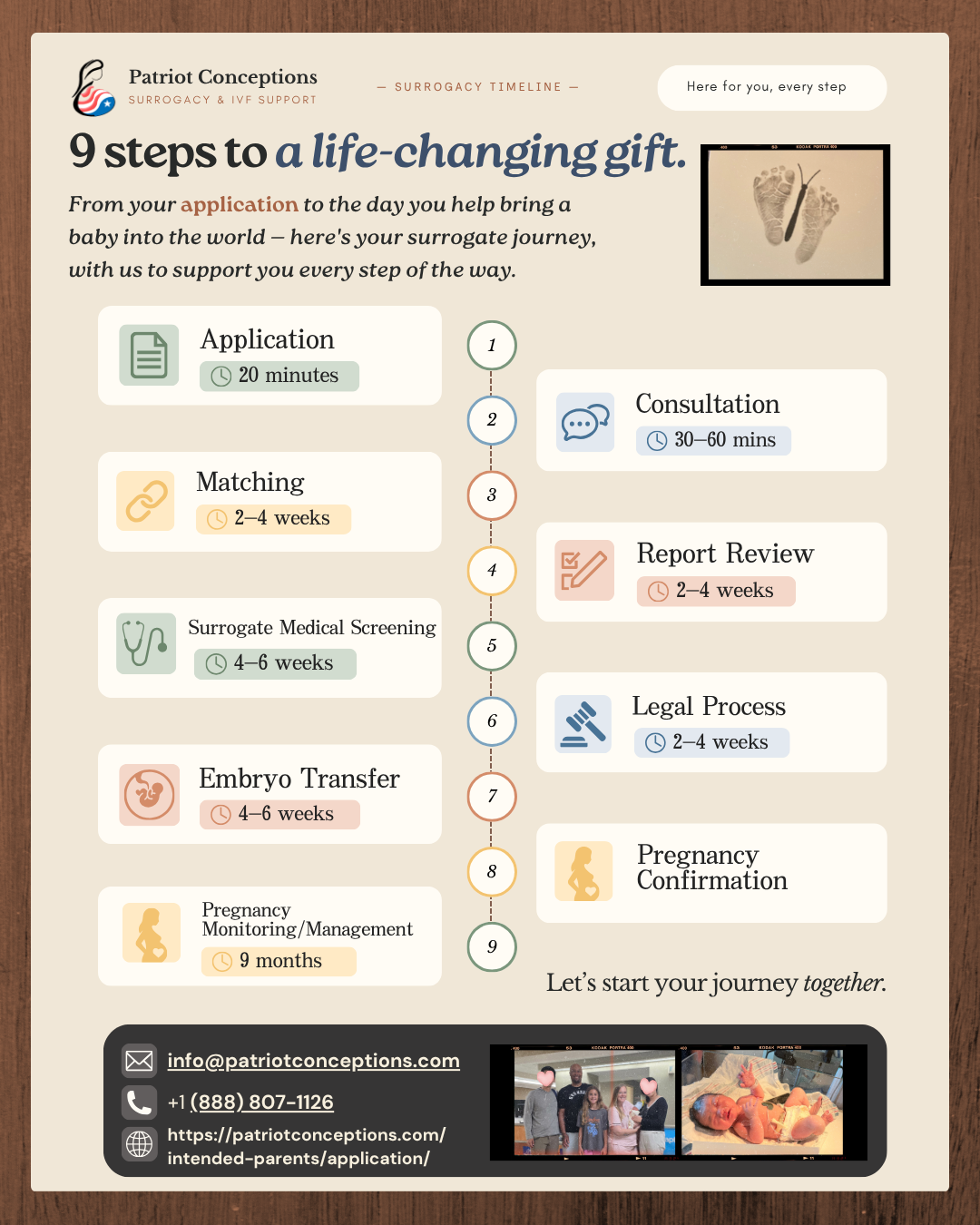
Stage 1: Initial planning and consultation
Typical timing: Several weeks, depending on your readiness
The journey begins before you view surrogate profiles. Intended parents first need to understand their goals, budget, medical circumstances, preferred timeline, and the type of support they expect from an agency.
During this stage, you may:
- Meet with a surrogacy agency.
- Review estimated costs and financing options.
- Consult a fertility clinic about embryo creation or existing embryos.
- Learn how state law may affect matching and parentage planning.
- Consider insurance, travel, and other third-party expenses.
Families who already have embryos may be able to move forward sooner than families who still need to complete an IVF or donor-egg cycle. It is better to resolve major medical, financial, and legal questions early than to build a timeline around assumptions.
Stage 2: Embryo creation, if needed
Typical timing: Variable
Not every intended parent begins the surrogacy process with embryos ready for transfer. If embryos still need to be created, the timeline may include fertility testing, an egg-retrieval cycle, fertilization, embryo development, and any testing recommended by the treating clinic.
The timing can differ significantly from one family to another. Donor selection, treatment scheduling, medication protocols, and the outcome of an IVF cycle may all affect how quickly embryos become available. Your fertility clinic, not the surrogacy agency, is the appropriate source for a personalized medical timeline.
Stage 3: Surrogate matching
Typical timing: Variable
Matching is not simply a matter of choosing the first available profile. A strong match considers compatibility between the intended parents and gestational carrier, including:
- Communication preferences.
- Views about pregnancy and medical decisions.
- Expectations for contact during and after the journey.
- Location and travel considerations.
- Clinic and legal eligibility.
- Agreement on important logistical and financial terms.
Some intended parents match quickly, while others need more time to find a relationship that feels right to everyone. Expanding reasonable preferences may create more possibilities, but intended parents and surrogates should never feel pressured to accept a match before they are comfortable.
Stage 4: Medical screening and legal agreements
Typical timing: Several weeks or longer
After a potential match is confirmed, the fertility clinic reviews the gestational carrier’s records and completes any required medical evaluation. The parties may also complete psychological consultation or other screening required by the clinic and professionals involved.
The legal stage follows the requirements of the applicable states and the family’s circumstances. Intended parents and the gestational carrier should have separate, independent attorneys. The attorneys prepare and negotiate the gestational-carrier agreement, covering matters such as compensation, expenses, insurance, medical expectations, communication, pregnancy management, and parentage planning.
Medical treatment should not begin until the appropriate legal documents and clinic clearance are in place. Legal review can take longer when questions require additional discussion, so families should allow time for both sides to understand and approve the agreement.
Stage 5: Embryo-transfer preparation
Typical timing: Approximately three to six weeks, depending on the clinic
Once medical and legal clearance are complete, the clinic creates a transfer calendar. The gestational carrier may begin medications and attend monitoring appointments while the clinic prepares for the frozen embryo transfer.
Clinic availability, medication response, test results, or personal scheduling may change the planned date. A delay does not necessarily mean that something is wrong; sometimes a cycle is adjusted because the medical team wants the safest conditions possible.
Stage 6: Embryo transfer and pregnancy confirmation
Typical timing: About two weeks to the first pregnancy test, followed by early monitoring
After the embryo transfer, the clinic schedules blood testing to determine whether implantation occurred. If the result is positive, additional blood tests and early ultrasounds may follow. The gestational carrier typically remains under the fertility clinic’s care during early pregnancy before transitioning to an obstetric provider.
Not every embryo transfer results in pregnancy. If a transfer is unsuccessful, the intended parents, gestational carrier, and clinic will discuss whether and when to try again. Another attempt can add weeks or months to the journey, depending on medical guidance and everyone’s readiness.
Stage 7: Pregnancy and parentage planning
Typical timing: Approximately nine months
Once the pregnancy is established, the journey moves into prenatal care. The gestational carrier makes decisions about her own medical care in consultation with her healthcare providers, while the intended parents remain involved according to the communication expectations everyone established.
During pregnancy, intended parents may also work with their attorney on the parentage process. The timing and procedure vary by state and family circumstances. Later in pregnancy, the agency, intended parents, gestational carrier, attorneys, and hospital may coordinate a delivery plan addressing communication, hospital logistics, newborn care, and discharge.
Stage 8: Delivery and post-birth arrangements
Typical timing: Variable
The baby’s arrival is a major milestone, but some practical work continues after delivery. Depending on the situation, intended parents may need to complete parentage documents, birth-certificate steps, hospital discharge arrangements, insurance coordination, and travel planning.
International intended parents should build additional flexibility into their plans. Passport, citizenship, immigration, and travel-document procedures depend on the family’s circumstances and current government requirements. These matters should be reviewed with qualified attorneys and other appropriate professionals well before delivery.
The gestational carrier also begins her postpartum recovery. Clear communication, respect for her recovery, and the support agreed upon during the legal process remain important after the birth.
What can make a surrogacy journey take longer?
Common reasons a timeline may change include:
- Embryos still need to be created.
- Matching takes longer than expected.
- A clinic requests additional medical information or testing.
- Legal negotiations require more time.
- The transfer calendar changes.
- An embryo transfer does not result in pregnancy.
- A rematch becomes necessary.
- Pregnancy or delivery plans change for medical reasons.
- International documents or travel arrangements require additional processing.
These possibilities are why a responsible agency should explain the sequence of the journey without guaranteeing an exact completion date.
How intended parents can prepare for the timeline
You cannot control every part of a surrogacy journey, but you can reduce avoidable delays by:
- Organizing medical and identification records early.
- Confirming whether embryos are ready before matching.
- Establishing a realistic budget and contingency reserve.
- Responding promptly to your agency, clinic, and attorneys.
- Choosing independent legal counsel familiar with assisted reproduction.
- Discussing communication and matching priorities clearly.
- Keeping travel plans flexible.
- Asking who is responsible for each upcoming step.
A timeline is a planning tool, not a promise
For many intended parents, surrogacy may take roughly 15 to 18 months, but the most accurate estimate is the one based on your actual starting point. A family with tested embryos, a clear legal plan, and broad matching preferences may follow a different timeline from a family that is beginning IVF or navigating international arrangements.
Instead of focusing on one promised completion date, ask what must happen before matching, before transfer, during pregnancy, and before the baby can go home. A clear sequence of milestones gives you a more reliable way to plan and helps you understand where flexibility may be needed.
Surrogacy is a legal and medical-adjacent topic. This article is for informational purposes only and is not legal or medical advice.
Reviewed by Patriot Conceptions Editorial Team. Last reviewed Jan 1, 2023.
How Long Does the Surrogacy Process Take? A Timeline for Intended Parents
A broad surrogacy journey may take around 15 to 18 months, but there is no single timeline that applies to every family. Some journeys take longer, especially when intended parents still need to create embryos, matching takes additional time, a clinic requests further screening, or more than one embryo transfer is needed.
The most useful way to understand the timeline is to look at the journey as a sequence of milestones rather than a guaranteed calendar. Your medical plan, embryo readiness, matching preferences, state-law considerations, clinic schedule, and the course of the pregnancy can all affect the total length.
Below is a practical overview of what intended parents can expect at each stage.
Stage 1: Initial planning and consultation
Typical timing: Several weeks, depending on your readiness
The journey begins before you view surrogate profiles. Intended parents first need to understand their goals, budget, medical circumstances, preferred timeline, and the type of support they expect from an agency.
During this stage, you may:
- Meet with a surrogacy agency.
- Review estimated costs and financing options.
- Consult a fertility clinic about embryo creation or existing embryos.
- Learn how state law may affect matching and parentage planning.
- Consider insurance, travel, and other third-party expenses.
Families who already have embryos may be able to move forward sooner than families who still need to complete an IVF or donor-egg cycle. It is better to resolve major medical, financial, and legal questions early than to build a timeline around assumptions.
Stage 2: Embryo creation, if needed
Typical timing: Variable
Not every intended parent begins the surrogacy process with embryos ready for transfer. If embryos still need to be created, the timeline may include fertility testing, an egg-retrieval cycle, fertilization, embryo development, and any testing recommended by the treating clinic.
The timing can differ significantly from one family to another. Donor selection, treatment scheduling, medication protocols, and the outcome of an IVF cycle may all affect how quickly embryos become available. Your fertility clinic, not the surrogacy agency, is the appropriate source for a personalized medical timeline.
Stage 3: Surrogate matching
Typical timing: Variable
Matching is not simply a matter of choosing the first available profile. A strong match considers compatibility between the intended parents and gestational carrier, including:
- Communication preferences.
- Views about pregnancy and medical decisions.
- Expectations for contact during and after the journey.
- Location and travel considerations.
- Clinic and legal eligibility.
- Agreement on important logistical and financial terms.
Some intended parents match quickly, while others need more time to find a relationship that feels right to everyone. Expanding reasonable preferences may create more possibilities, but intended parents and surrogates should never feel pressured to accept a match before they are comfortable.
Stage 4: Medical screening and legal agreements
Typical timing: Several weeks or longer
After a potential match is confirmed, the fertility clinic reviews the gestational carrier’s records and completes any required medical evaluation. The parties may also complete psychological consultation or other screening required by the clinic and professionals involved.
The legal stage follows the requirements of the applicable states and the family’s circumstances. Intended parents and the gestational carrier should have separate, independent attorneys. The attorneys prepare and negotiate the gestational-carrier agreement, covering matters such as compensation, expenses, insurance, medical expectations, communication, pregnancy management, and parentage planning.
Medical treatment should not begin until the appropriate legal documents and clinic clearance are in place. Legal review can take longer when questions require additional discussion, so families should allow time for both sides to understand and approve the agreement.
Stage 5: Embryo-transfer preparation
Typical timing: Approximately three to six weeks, depending on the clinic
Once medical and legal clearance are complete, the clinic creates a transfer calendar. The gestational carrier may begin medications and attend monitoring appointments while the clinic prepares for the frozen embryo transfer.
Clinic availability, medication response, test results, or personal scheduling may change the planned date. A delay does not necessarily mean that something is wrong; sometimes a cycle is adjusted because the medical team wants the safest conditions possible.
Stage 6: Embryo transfer and pregnancy confirmation
Typical timing: About two weeks to the first pregnancy test, followed by early monitoring
After the embryo transfer, the clinic schedules blood testing to determine whether implantation occurred. If the result is positive, additional blood tests and early ultrasounds may follow. The gestational carrier typically remains under the fertility clinic’s care during early pregnancy before transitioning to an obstetric provider.
Not every embryo transfer results in pregnancy. If a transfer is unsuccessful, the intended parents, gestational carrier, and clinic will discuss whether and when to try again. Another attempt can add weeks or months to the journey, depending on medical guidance and everyone’s readiness.
Stage 7: Pregnancy and parentage planning
Typical timing: Approximately nine months
Once the pregnancy is established, the journey moves into prenatal care. The gestational carrier makes decisions about her own medical care in consultation with her healthcare providers, while the intended parents remain involved according to the communication expectations everyone established.
During pregnancy, intended parents may also work with their attorney on the parentage process. The timing and procedure vary by state and family circumstances. Later in pregnancy, the agency, intended parents, gestational carrier, attorneys, and hospital may coordinate a delivery plan addressing communication, hospital logistics, newborn care, and discharge.
Stage 8: Delivery and post-birth arrangements
Typical timing: Variable
The baby’s arrival is a major milestone, but some practical work continues after delivery. Depending on the situation, intended parents may need to complete parentage documents, birth-certificate steps, hospital discharge arrangements, insurance coordination, and travel planning.
International intended parents should build additional flexibility into their plans. Passport, citizenship, immigration, and travel-document procedures depend on the family’s circumstances and current government requirements. These matters should be reviewed with qualified attorneys and other appropriate professionals well before delivery.
The gestational carrier also begins her postpartum recovery. Clear communication, respect for her recovery, and the support agreed upon during the legal process remain important after the birth.
What can make a surrogacy journey take longer?
Common reasons a timeline may change include:
- Embryos still need to be created.
- Matching takes longer than expected.
- A clinic requests additional medical information or testing.
- Legal negotiations require more time.
- The transfer calendar changes.
- An embryo transfer does not result in pregnancy.
- A rematch becomes necessary.
- Pregnancy or delivery plans change for medical reasons.
- International documents or travel arrangements require additional processing.
These possibilities are why a responsible agency should explain the sequence of the journey without guaranteeing an exact completion date.
How intended parents can prepare for the timeline
You cannot control every part of a surrogacy journey, but you can reduce avoidable delays by:
- Organizing medical and identification records early.
- Confirming whether embryos are ready before matching.
- Establishing a realistic budget and contingency reserve.
- Responding promptly to your agency, clinic, and attorneys.
- Choosing independent legal counsel familiar with assisted reproduction.
- Discussing communication and matching priorities clearly.
- Keeping travel plans flexible.
- Asking who is responsible for each upcoming step.
A timeline is a planning tool, not a promise
For many intended parents, surrogacy may take roughly 15 to 18 months, but the most accurate estimate is the one based on your actual starting point. A family with tested embryos, a clear legal plan, and broad matching preferences may follow a different timeline from a family that is beginning IVF or navigating international arrangements.
Instead of focusing on one promised completion date, ask what must happen before matching, before transfer, during pregnancy, and before the baby can go home. A clear sequence of milestones gives you a more reliable way to plan and helps you understand where flexibility may be needed.
For your own case, confirm legal and medical details with your attorney and clinic.
Reviewed by Patriot Conceptions Editorial Team. Last reviewed Jan 1, 2023.